Being Everything to Everyone Made Us the Obvious Choice for Nobody

What XL PR is narrowing down on:

I’ve always believed that entrepreneurs were born to make a difference AND build something wildly successful. I always hoped I didn’t have to pick one, and I’ve always tried to do it all. To make a difference, my company gives contractors access to a career coach, 4 team retreats a year, a book club, and membership to the BEST media relations training out there among other things. And on the business side, let me give you a peek.

For a while, we were losing clients faster than we were signing them. And if you’ve ever been the founder, the one everybody is counting on, you know that exact feeling.

Being everything to everyone meant we were the obvious choice for nobody. I thought staying broad helped us serve a LOT of clients (15 different industries to be exact), but it turns out maybe I was missing something,

If we represent clients in the same industry, am I about to walk into a reporter’s inbox with 30 versions of the same client? Won’t they start to blur together? Won’t I be competing against myself?

So I had to step back and look at the clients who we were passionate about including ones who not only got the wildest results but actually listened to us and it was a true collaboration.

Some of our biggest wins? We took BookSmarts to $13.73M in earned media value, landed 140 placements, built a 25% revenue lift, grew their organic SEO by 700%, brought in 60+ new clients, earned them awards, and won a Golden Spike against billion-dollar competitors while shedding light on her personal financial journey of paying off over $200k in student loans in under 3 years. Utah Radon: 6,000 test requests and partnerships with major hospitals. North Star Recovery: investor relations and five recovering addicts furnished and moved into homes. Youth Futures: more donors and real brand awareness for homeless youth.

What are XL PR’s strengths?

When we looked back at the clients who brought out our best work, we expected to see a list of unrelated industries. An accounting firm. A radon-testing company. A recovery center. A tulip farm. A homebuilder. A children’s book company. On paper, they have almost nothing in common.

But realized they could be grouped into two categories: Behavioral finance and behavioral health.

Behavioral finance is the people and businesses helping everyday Americans build a healthier relationship with their money. Accounting and bookkeeping that takes the shame out of the numbers. Homeownership is made attainable for working families. Employees finally are able to save for a place of their own.

Behavioral and environmental health is addiction recovery, trauma, mental health, and the physical environments we live inside every day.

A lot of these stories most people are too scared to say out loud, but we want to tell these stories.

Here is a visual that will help:
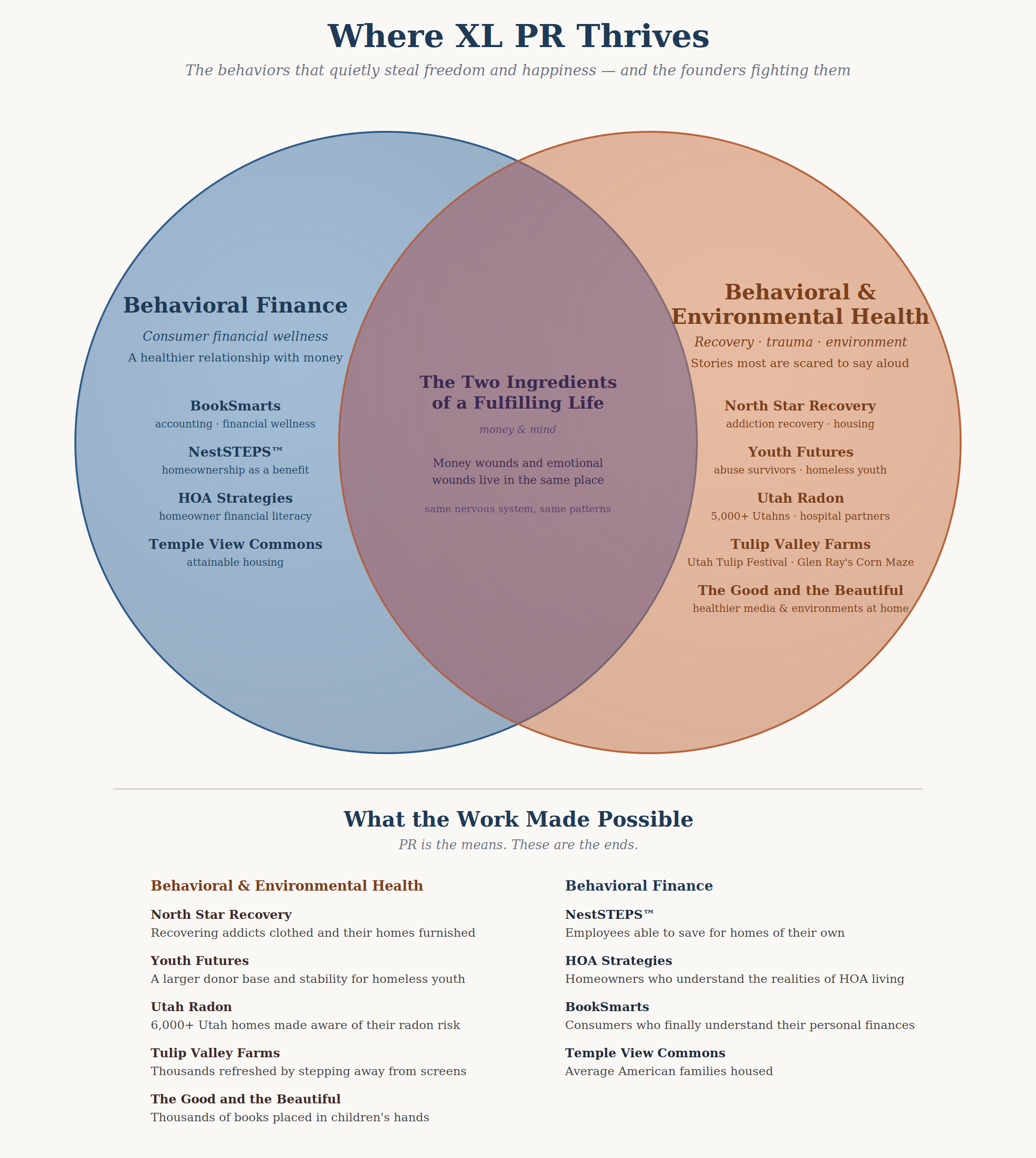
XL PR shows their two niches, Behavioral and Environmental Health and Behavioral Finance

Why does XL PR care so much about Behavioral Finance and Behavioral and Environmental Health?

These are industries so personal to me.

I don’t just talk about financial discipline, I live it. I read Dave Ramsey in high school, tracked every expense for seven years straight, bought my first home on my own income, put money in a Roth IRA every single month for over four years even when money was tight, and never once took on a car loan, and implemented profit first in my company. I’ve been the breadwinner for years and built XL PR from zero to $715K in under three years. And you know what I STILL have triggers and shame around money that I’m working through!!

I bring that same lived experience to behavioral health. I have three neurodiverse kids. There have been social workers in my home three days a week. I walked my husband through two years of long COVID and years of other behavioral issues. My dad has Parkinson’s and is slowing declining. I have a therapist, somatic worker, anger management coach, and a nervous system regulation women’s group and do couples therapy. The taboo stuff that keeps most people quiet is exactly where I’m most at home.

And my business partner in crime aka success also lives in those same veins with me. Rachelle also lives debt free, makes no excuses, and fights hard for the companies trying to make the world healthier and better, with the exception of Diet Coke/Coca-Cola, she fights hard for that company too ;). She has a public health degree from UVU, led the school’s first-ever student-to-student giving campaign, planned events and prevention education for The Center for Women and Children in Crisis, and led the financial services PR work behind BookSmarts’s whole campaign.

What can XL PR do?

So here’s what we’re building from here. XL PR is the go-to agency in these two spaces, behavioral finance and behavioral health. We are working on the podcast connections, the earned media relationships, we will be facilitating collaborations between clients so they grow faster together, we know the events our clients need to be attending in the industry, and we have a real, deep understanding of the strategy. We deliver PR that drives real business results.

And we aren’t stopping at media placements either. There’s more coming: full funnel PR. But more on that soon.

For now, we’ve got a few more fun things landing this summer, including a brand-new website that brings all of this to life, coming toward the beginning of July.

XL PR jumping for joy because they are so excited to continue to serve businesses in behavioral finance and behavioral and environmental health!

There’s so much to be excited about, and XL PR is so excited. So if you’re a founder in behavioral finance or behavioral health sitting on a story that deserves to be heard, don’t hesitate to reach out. Let’s chat!

Schedule a call with us to discuss how we can help your business!

From Crisis Mode to Reputation Gold: How to Turn a Crisis into an Opportunity

Here’s what I know after working with mission-driven organizations: crises are inevitable. But reputation destruction is optional.

The problem is most people don’t know how to prepare for a PR crisis.

Most leaders think crisis management is about damage control, minimizing the fallout, issuing a statement, and moving on. But that’s not what the most resilient companies do. The ones who emerge from a crisis stronger than before? They understand something most people miss: a crisis is actually a reputation-building opportunity if you handle it right.

This doesn’t mean we’re grateful for crises. It means we’re strategic about them.

XL PR team members present on Crisis Management at the Utah School Public Relations Association Conference

What Even Is a Crisis?

Before we talk about how to navigate one, let’s define what we’re actually dealing with.

A crisis is an unintended event—a threat to your organization’s reputation, operations, or stakeholders. It’s not your fault that it happened. But how you respond? That’s entirely on you.

The reality is that crises come in three flavors:

  1. Those you WANT the public to know about (policy stance, plaintiff suit, death of a public figure, etc.)

  2. Those you DON’T want the public to know about (mistakes that don’t affect the public, just hurt your reputation)

  3. Those the public DOES or SHOULD know about (data breach, health hazard, etc.)

No matter which type hits you, the path forward is the same: preparation, speed, and intention.

The Three Phases of Crisis Management (And Why Most People Only Understand One)

Here’s the problem: most organizations only think about phase two: The Crisis. They prepare for the moment of crisis but ignore the before and the after. That’s a missed opportunity.

Effective crisis management happens in three distinct phases, and you need a crisis communications strategy for each one.

Phase 1: Crisis Planning (The Work You Do Before You Need It)

Key Takeaway: Preparation Protects Reputation

This is the phase where you’re sitting in relative calm, and frankly, it’s boring. Nobody wants to think about worst-case scenarios when everything is running smoothly. But here’s the hard truth: your crisis response is only as good as your planning.

But how do you plan for an unexpected situation?

How to Prepare for a PR Crisis

You may not know exactly what will happen, but you can predict and plan for most likely scenarios.

During the planning phase, you will need to build a crisis communications strategy, which should include:

  • A crisis team with defined roles: Who makes decisions? Who talks to the media? Who manages internal communications? If you don’t have clear roles assigned before a crisis hits, you’ll waste critical time figuring it out while the situation escalates.

  • Team logistics: Where will your team convene? How will you notify them if something breaks at 2 a.m.? What communication channels will you use? Decide this now.

  • Likely scenarios: You can’t plan for every possible crisis, but you can anticipate the ones most likely to hit your organization. Map those out. Build individual plans for each scenario.

  • Holding statements: Create template statements that can be customized and released within the first 45 minutes of a crisis. These are your fast-response tools. Have them ready.

  • Key messages: What are your primary messages? What are your secondary messages? Make sure every person on your team knows them and can speak to them consistently. Nothing destroys credibility faster than mixed messaging.

  • Clear communication protocols: Your best scenario is one where the public finds out from YOU, not from a secondary reporting source. This means you have to have protocols in place to communicate to each public, and you need to act fast.

Make sure to run everything by your legal counsel before you finalize it. Crisis communication and legal strategy need to be aligned.

The organizations that handle crises with grace? They did this work in advance. They don’t react. They execute.

Phase 2: Crisis Response (The Critical First Hours)

Key Takeaway: Speed + Clarity Build Credibility

This is where most organizations lose the narrative.

The first 45 to 90 minutes after a crisis event are make-or-break. In that window, journalists are calling, social media is spinning, rumors are spreading, and your stakeholders are looking to you for clarity. If you don’t provide it, someone else will.

The goal during this phase isn’t to have all the answers. It’s to communicate that you’re taking it seriously and you’re in control.

Here’s where strategic response beats reactive panic:

Strategic Response looks like:

  • Goal-oriented messaging

  • Defined objectives, roles, and messages

  • Alignment across your entire organization

Reactive Panic looks like:

  • Scattered, emotional messaging

  • Unclear objectives and muddy roles

  • Mixed messages and rogue spokespeople (the kiss of death)

During this phase, you need a messaging formula. Here’s what we recommend:

  1. Acknowledge and validate the concern. Show you understand the impact this has on your stakeholders.

  2. Provide known facts. Only state what you know for certain. Speculation is the enemy.

  3. State next steps. What are you doing about this? What will the community see from you?

  4. Reinforce values. Connect your response back to who you are as an organization.

The language matters here. You’re not being defensive. You’re being clear. There’s a huge difference.

Let me address the elephant in the room because I get asked this constantly: “But what do I do when rumors are flying? When the media is pressuring me for answers I don’t have? When people are reporting incorrect information?”

Here’s what you don’t do: you don’t panic. You don’t speculate. You don’t get defensive.

Here’s what you do: you acknowledge the situation, you commit to a transparent investigation, and you refuse to comment on specifics until you have verified information. You say things like:

“We’re aware of these reports, and we take them seriously. We’re conducting a thorough investigation and will share verified information as it becomes available. In the meantime, we’re committed to ensuring the safety and support of our community.”

That’s not evasive. That’s credible.

Phase 3: Reputation Rebuild (The Golden Opportunity Most Organizations Miss)

Key Takeaway: Recovery is Where Reputation Is Built

This is the phase I get most excited about because here’s what most organizations don’t realize: how you show up during recovery determines how people remember the crisis itself.

You have a golden window after the immediate crisis passes to rebuild trust, and the way you do that isn’t by pretending nothing happened. It’s by being intentional about moving forward.

During this phase, focus on three things:

  1. Transparency: Keep giving updates. Show that you’re taking responsibility and making systemic changes to prevent similar crises.

  2. Leadership highlights: Help people see that competent, caring people are steering the ship.

  3. Mission and values: Tell stories about who you are and what you stand for. Use this moment to actually connect with your community.

  4. Reputation management: How can you use your current position in the public eye to make a positive impact on your reputation?

We like to use the Aftercare Method, a tool that separates organizations that rebuild from those that just survive:

  • Follow-up updates. Don’t disappear after the crisis passes. Keep the community informed of progress and changes.

  • Community listening. Hear what people are feeling. Their feedback will shape how you move forward.

  • Internal morale support. Your team has been through something. Make sure they feel supported and valued.

  • Strategic storytelling. What positive stories can you tell that reinforce the values you’re claiming to protect? Lean into these intentionally. You’re already in the news. Use it. Drown out the negative with the positive and control the narrative going forward.

Remember that reputation management after a crisis isn’t about returning to the same old, same old. It’s about building on that reputation and becoming something better.

Don’t miss the opportunity to keep your name in the public mind. This is where reputation gold gets made.

The 3 Phases of Crisis Management

The Honest Truth

Here’s what I want you to know: every organization will face a crisis. The question isn’t if, but when.

The organizations that emerge stronger are the ones that:

  • Prepare before they need to

  • Respond with speed and clarity, not emotion

  • Use the recovery phase as an intentional opportunity to rebuild trust

Your crisis doesn’t define you. How you respond to it does.

And the beautiful part? If you handle it right, you’ll rebuild a reputation even stronger than the one you had before the crisis hit.

Ready to prepare your organization for what might come? At XL PR, we help mission-driven organizations develop comprehensive crisis communication strategies that protect reputation and build resilience. Let’s talk about your preparedness plan.

Schedule a call with us to discuss your organization’s crisis readiness.