
Utah executives: Learn to quantify PR success beyond vanity metrics. This guide outlines key KPIs and a framework for measuring the true business impact of your PR.
Continue reading
Utah executives: Learn to quantify PR success beyond vanity metrics. This guide outlines key KPIs and a framework for measuring the true business impact of your PR.
Continue reading
Curious about PR agency costs in Utah? Our guide breaks down pricing models like retainers, project fees, and hourly rates, with typical ranges from $3,000 to over $15,000 a month.
Continue reading
Executive visibility in public relations means positioning leaders as credible experts. Learn why it matters for your brand’s growth and how to build it.
Continue reading
Discover the types of Utah businesses that get the highest return from public relations, from Silicon Slopes tech startups to health and finance experts.
Continue reading
For B2B companies in specialized fields, is a niche or generalist PR firm better? Learn the key differences and how to choose the right agency for you.
Continue reading
Are you trying to increase your GEO visibility? Then this case study may be for you.
In May, we asked ChatGPT, Claude, Gemini, and Google’s AI snippets 17 questions that NestSTEPS’ buyers are likely to ask an LLM: What are housing benefits for employees? How do housing benefits impact retention? What are unique financial wellness benefits beyond standard retirement plans?
We asked these questions in an incognito window and NestSTEPS did not appear in any of them across 68 chances.
Not only did it have 0 mentions, but we also asked the engines to compare NestSTEPS to their competitor. This is the one question where you hand the model the name, and it should be impossible to get wrong. The model confused them with an unrelated field-service software company called Next Steps and explained that the two businesses do not compete (doi!) They mentioned the wrong company completely.
Ten weeks later we ran the same 17 questions through the same LLMs. NestSTEPS appeared in 8.8 percent of the answers, and was named first when someone asked which vendors to consider. We also didn’t have any confusion with Next Steps like the first round!

[SCREENSHOT 1: the AI bot traffic chart filtered to OpenAI user bot, flat through June and July, spiking the week of August 7. Caption: retrieval traffic to neststepsbenefits.com, last 90 days.]
NestSTEPS is a Utah-based startup solving the housing crisis by involving employers. Their argument is that employers are already in the business of helping people build long-term financial security through the 401(k). Homeownership is just as demanded and important. Makes so much sense right? We think so too!
Their product has three layers targeted to make it easy for an employer to say yes.
First they utilize a home savings plan and account. This is an automated savings system that holds employee contributions in a separate FDIC-insured account earmarked for a home purchase.
Second is the employer contribution. Companies decide how much they put in, who qualifies, when it vests, and whether the money goes toward buying a home or paying down an existing mortgage. That flexibility is what benefits leaders respond to. It lets a 200-person company and a 5,000-person company build customizable benefit options for their employees.
Third is education and guidance. Saving is almost always a behavioral problem. Buying a house when you haven’t ever bought one before has a learning curve to it. This education course covers both financial knowledge and home-buying processes. The education sets up the employees for success and empowerment.
ChatGPT doesn’t mention your company name because there are no third-party trusted sources mentioning you.
AI answer engines do not rank pages the way search does. They select a few sources they trust such as Entrepreneur Magazine or Employee Benefit News. It synthesizes the answer from multiple digital resources and then returns an answer that already contains a verdict. If your name is not in the sources or answer, then your buyer never knows you exist.
Yes, earned media helped increase GEO visibility for NestSTEPS, though not the way we assumed.
When we re-ran the questions in August, the EBN article showed up as a cited source in Claude and in Google’s AI snippets. Claude specifically identified the Employee Benefit News piece published on August 3 as a primary source.
In ChatGPT, it never appeared in the source list at all. What appeared instead was neststepsbenefits.com, cited for the survey data.
Image 2: the ChatGPT sources panel showing Foyer, NestSTEPS, EIN Presswire, Benefit News, and Reddit. Caption: five sources, three of them from our efforts

Interestingly, Muck Rack’s Generative Pulse study found that wire syndication accounts for roughly 1.1 percent of AI citations while earned media accounts for about 84 percent. So we found it surprising that the wire release got cited too, by Google, through a syndicated version on a Gannett newspaper site. To increase your GEO visibility, it is important to have consistent content on several different platforms for AI to make conclusions from; this was a good example of that.

The resources that were cited differently in each LLM worked together, each serving a different purpose. When a model needed the data from the survey, it went to the client’s site. If it needed proof that employer-sponsored homeownership is a credible category and not one startup’s idea, it went to EBN. When it needed to know who NestSTEPS had partnered with and when, it went to the press release.
AI retrieval hits to the NestSTEPS site were essentially flat through June and most of July, then jumped to more than 400 in a single day the week after the EBN article ran. We cannot pin that spike on any one input. What we can say is that the increase in GEO visibility happened once all four strategies were published. Four days after a trade publication puts the client’s research in front of the people who buy this category is reasonable timing for the demand to increase.

[DIAGRAM: the citation architecture graphic showing EIN Presswire, the NestSTEPS PR page, the EBN article, and Reddit threads all carrying the survey figure and resolving to the NestSTEPS report page.]
Seventeen unbranded questions across four engines gives 68 places NestSTEPS could have appeared.
In May and June, NestSTEPS didn’t appear in any answers.
By August, they appeared in six. That is 8.8 percent of possible answers. Three of the six were organic and three we requested that they cite sources and were able to find what data it was citing. That is a significant increase in their GEO visibility.

The most exciting part of the experiment is that we asked: Who provides employer-sponsored homeownership benefits? And who is the best homeownership benefit vendors for a 500-person company? ChatGPT named NestSTEPS first in both.


[SCREENSHOT 3: the ChatGPT vendor shortlist naming NestSTEPS first, with the “my first call for a retention strategy” line visible.]
And the comparison question that produced the field-service software mix-up in May came back correct in August across all four surfaces, including Google.
Look at how the NestSTEPS press release is built. The survey findings sit in an FAQ block, directly under headers phrased as questions. Some PR pros are calling this format an AI notice that makes it easy for AI bots to crawl and synthesize information.
How do I know if my brand appears in AI answers? Write 15 to 20 questions a buyer would actually type. Run them through ChatGPT, Claude, and Gemini. Record whether you appear and who appears instead. Do it before you start any campaign, then re-run the identical questions after.
Does a press release help with AI visibility? Aggregate studies put wire syndication at a tiny share of AI citations. In our sample it still produced one, through a syndicated version on a news site. Treat the wire as a way to get facts indexed and findable, but do not rely on it heavily.
Should we publish original research to get cited by AI? If you can afford it, yes. Owning a statistic makes you the only possible primary source for it, so every path that leads to that number eventually leads back to you.
How many placements does it take to change an AI answer? We do not know, and anyone who gives you a number is guessing. What we saw was movement after four coordinated inputs over roughly ten weeks.
What is the difference between being mentioned and being cited? A mention is your name in the text. A citation is your name in the source list, usually with a link. Mentions are good. Citations compound.
If you want to know what your buyers are hearing about you when they go looking… follow this process and see what you find.
Do you need more assistance increasing your GEO visibility through PR? One of our GEO specialists is always willing to help. We’d love to here from you: contact us.

I’ve always believed that entrepreneurs were born to make a difference AND build something wildly successful. I always hoped I didn’t have to pick one, and I’ve always tried to do it all. To make a difference, my company gives contractors access to a career coach, 4 team retreats a year, a book club, and membership to the BEST media relations training out there among other things. And on the business side, let me give you a peek.
For a while, we were losing clients faster than we were signing them. And if you’ve ever been the founder, the one everybody is counting on, you know that exact feeling.
Being everything to everyone meant we were the obvious choice for nobody. I thought staying broad helped us serve a LOT of clients (15 different industries to be exact), but it turns out maybe I was missing something,
If we represent clients in the same industry, am I about to walk into a reporter’s inbox with 30 versions of the same client? Won’t they start to blur together? Won’t I be competing against myself?
So I had to step back and look at the clients who we were passionate about including ones who not only got the wildest results but actually listened to us and it was a true collaboration.
Some of our biggest wins? We took BookSmarts to $13.73M in earned media value, landed 140 placements, built a 25% revenue lift, grew their organic SEO by 700%, brought in 60+ new clients, earned them awards, and won a Golden Spike against billion-dollar competitors while shedding light on her personal financial journey of paying off over $200k in student loans in under 3 years. Utah Radon: 6,000 test requests and partnerships with major hospitals. North Star Recovery: investor relations and five recovering addicts furnished and moved into homes. Youth Futures: more donors and real brand awareness for homeless youth.
When we looked back at the clients who brought out our best work, we expected to see a list of unrelated industries. An accounting firm. A radon-testing company. A recovery center. A tulip farm. A homebuilder. A children’s book company. On paper, they have almost nothing in common.
But realized they could be grouped into two categories: Behavioral finance and behavioral health.
Behavioral finance is the people and businesses helping everyday Americans build a healthier relationship with their money. Accounting and bookkeeping that takes the shame out of the numbers. Homeownership is made attainable for working families. Employees finally are able to save for a place of their own.
Behavioral and environmental health is addiction recovery, trauma, mental health, and the physical environments we live inside every day.
A lot of these stories most people are too scared to say out loud, but we want to tell these stories.
Here is a visual that will help:
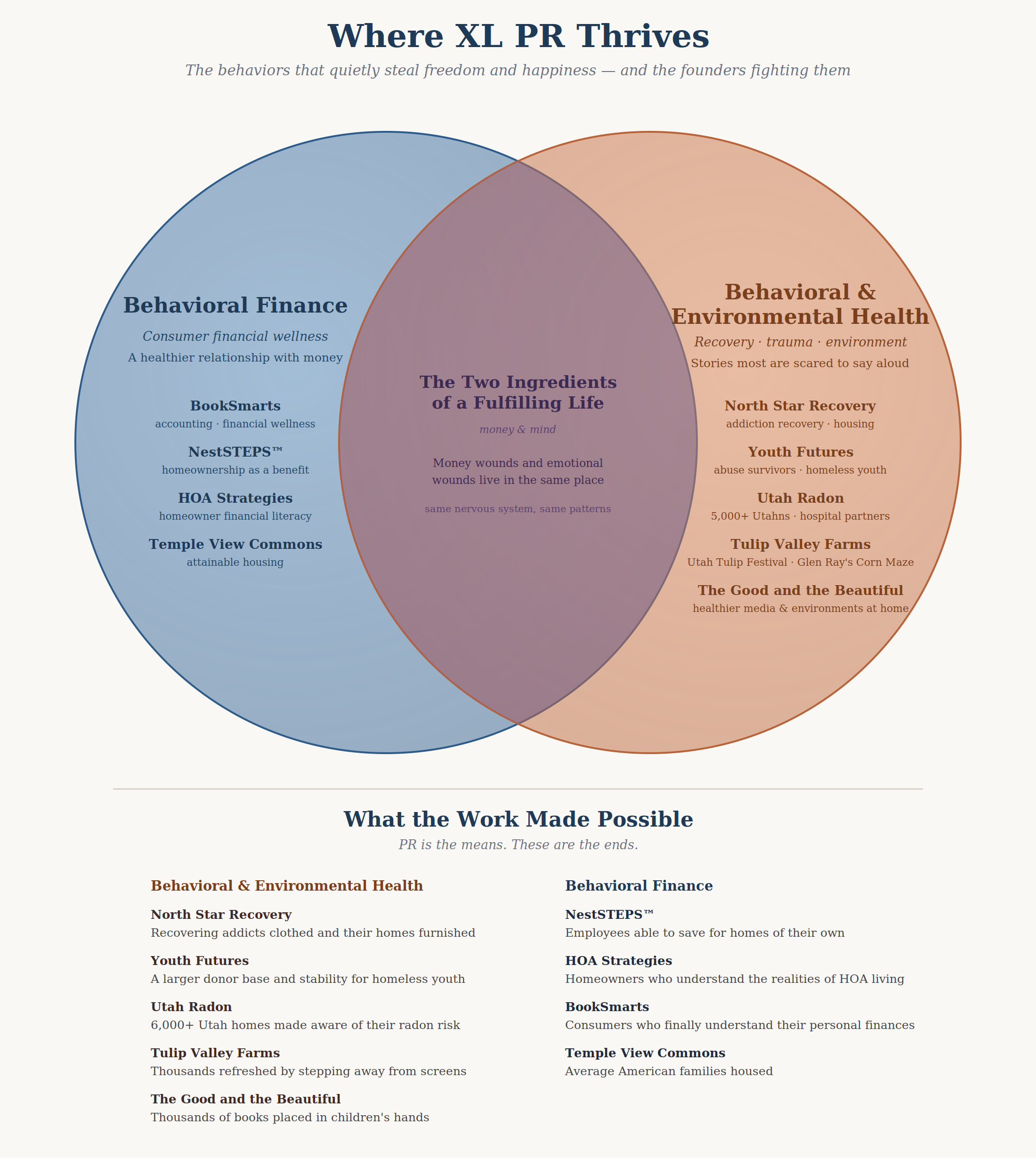
XL PR shows their two niches, Behavioral and Environmental Health and Behavioral Finance
These are industries so personal to me.
I don’t just talk about financial discipline, I live it. I read Dave Ramsey in high school, tracked every expense for seven years straight, bought my first home on my own income, put money in a Roth IRA every single month for over four years even when money was tight, and never once took on a car loan, and implemented profit first in my company. I’ve been the breadwinner for years and built XL PR from zero to $715K in under three years. And you know what I STILL have triggers and shame around money that I’m working through!!
I bring that same lived experience to behavioral health. I have three neurodiverse kids. There have been social workers in my home three days a week. I walked my husband through two years of long COVID and years of other behavioral issues. My dad has Parkinson’s and is slowing declining. I have a therapist, somatic worker, anger management coach, and a nervous system regulation women’s group and do couples therapy. The taboo stuff that keeps most people quiet is exactly where I’m most at home.
And my business partner in crime aka success also lives in those same veins with me. Rachelle also lives debt free, makes no excuses, and fights hard for the companies trying to make the world healthier and better, with the exception of Diet Coke/Coca-Cola, she fights hard for that company too ;). She has a public health degree from UVU, led the school’s first-ever student-to-student giving campaign, planned events and prevention education for The Center for Women and Children in Crisis, and led the financial services PR work behind BookSmarts’s whole campaign.
So here’s what we’re building from here. XL PR is the go-to agency in these two spaces, behavioral finance and behavioral health. We are working on the podcast connections, the earned media relationships, we will be facilitating collaborations between clients so they grow faster together, we know the events our clients need to be attending in the industry, and we have a real, deep understanding of the strategy. We deliver PR that drives real business results.
And we aren’t stopping at media placements either. There’s more coming: full funnel PR. But more on that soon.
For now, we’ve got a few more fun things landing this summer, including a brand-new website that brings all of this to life, coming toward the beginning of July.

XL PR jumping for joy because they are so excited to continue to serve businesses in behavioral finance and behavioral and environmental health!
There’s so much to be excited about, and XL PR is so excited. So if you’re a founder in behavioral finance or behavioral health sitting on a story that deserves to be heard, don’t hesitate to reach out. Let’s chat!
Schedule a call with us to discuss how we can help your business!

Here’s what I know after working with mission-driven organizations: crises are inevitable. But reputation destruction is optional.
The problem is most people don’t know how to prepare for a PR crisis.
Most leaders think crisis management is about damage control, minimizing the fallout, issuing a statement, and moving on. But that’s not what the most resilient companies do. The ones who emerge from a crisis stronger than before? They understand something most people miss: a crisis is actually a reputation-building opportunity if you handle it right.
This doesn’t mean we’re grateful for crises. It means we’re strategic about them. Below are the three phases of crisis management, and exactly what to do in each one.
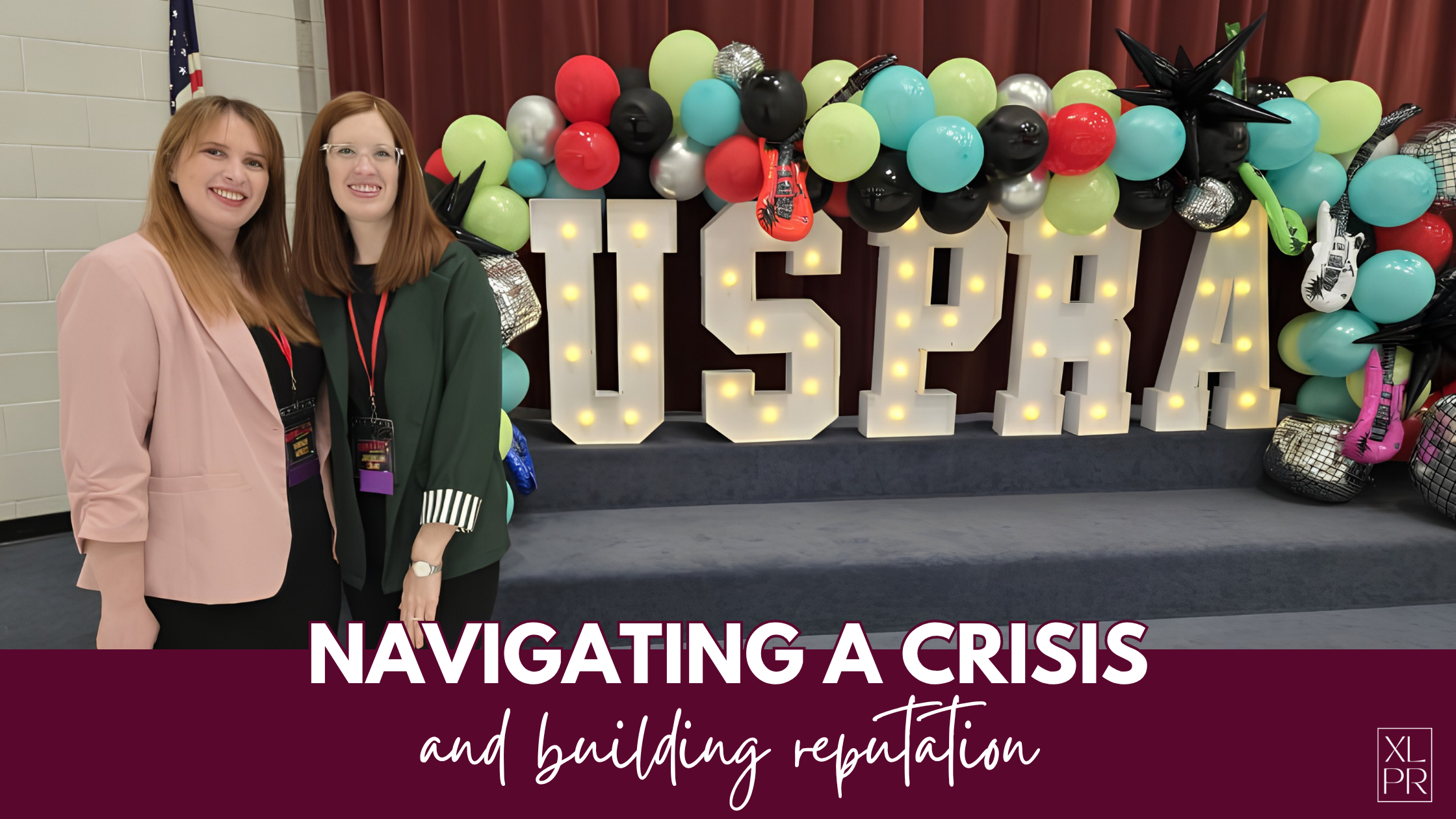
XL PR team members present on Crisis Management at the Utah School Public Relations Association Conference
Before we talk about how to navigate one, let’s define what we’re actually dealing with.
A crisis is an unintended event—a threat to your organization’s reputation, operations, or stakeholders. It’s not your fault that it happened. But how you respond? That’s entirely on you.
The reality is that crises come in three flavors:
Those you WANT the public to know about (policy stance, plaintiff suit, death of a public figure, etc.)
Those you DON’T want the public to know about (mistakes that don’t affect the public, just hurt your reputation)
Those the public DOES or SHOULD know about (data breach, health hazard, etc.)
No matter which type hits you, the path forward is the same: preparation, speed, and intention.
Here’s the problem: most organizations only think about phase two: The Crisis. They prepare for the moment of crisis but ignore the before and the after. That’s a missed opportunity.
Effective crisis management happens in three distinct phases, and you need a crisis communications strategy for each one.
Key Takeaway: Preparation Protects Reputation
This is the phase where you’re sitting in relative calm, and frankly, it’s boring. Nobody wants to think about worst-case scenarios when everything is running smoothly. But here’s the hard truth: your crisis response is only as good as your planning.
But how do you plan for an unexpected situation?
You may not know exactly what will happen, but you can predict and plan for most likely scenarios.
During the planning phase, you will need to build a crisis communications strategy, which should include:
A crisis team with defined roles: Who makes decisions? Who talks to the media? Who manages internal communications? If you don’t have clear roles assigned before a crisis hits, you’ll waste critical time figuring it out while the situation escalates.
Team logistics: Where will your team convene? How will you notify them if something breaks at 2 a.m.? What communication channels will you use? Decide this now.
Likely scenarios: You can’t plan for every possible crisis, but you can anticipate the ones most likely to hit your organization. Map those out. Build individual plans for each scenario.
Holding statements: Create template statements that can be customized and released within the first 45 minutes of a crisis. These are your fast-response tools. Have them ready.
Key messages: What are your primary messages? What are your secondary messages? Make sure every person on your team knows them and can speak to them consistently. Nothing destroys credibility faster than mixed messaging.
Clear communication protocols: Your best scenario is one where the public finds out from YOU, not from a secondary reporting source. This means you have to have protocols in place to communicate to each public, and you need to act fast.
Make sure to run everything by your legal counsel before you finalize it. Crisis communication and legal strategy need to be aligned.
The organizations that handle crises with grace? They did this work in advance. They don’t react. They execute.
Key Takeaway: Speed + Clarity Build Credibility
This is where most organizations lose the narrative.
The first 45 to 90 minutes after a crisis event are make-or-break. In that window, journalists are calling, social media is spinning, rumors are spreading, and your stakeholders are looking to you for clarity. If you don’t provide it, someone else will.
The goal during this phase isn’t to have all the answers. It’s to communicate that you’re taking it seriously and you’re in control.
Here’s where strategic response beats reactive panic:
Strategic Response looks like:
Goal-oriented messaging
Defined objectives, roles, and messages
Alignment across your entire organization
Reactive Panic looks like:
Scattered, emotional messaging
Unclear objectives and muddy roles
Mixed messages and rogue spokespeople (the kiss of death)
During this phase, you need a messaging formula. Here’s what we recommend:
Acknowledge and validate the concern. Show you understand the impact this has on your stakeholders.
Provide known facts. Only state what you know for certain. Speculation is the enemy.
State next steps. What are you doing about this? What will the community see from you?
Reinforce values. Connect your response back to who you are as an organization.
The language matters here. You’re not being defensive. You’re being clear. There’s a huge difference.
Let me address the elephant in the room because I get asked this constantly: “But what do I do when rumors are flying? When the media is pressuring me for answers I don’t have? When people are reporting incorrect information?”
Here’s what you don’t do: you don’t panic. You don’t speculate. You don’t get defensive.
Here’s what you do: you acknowledge the situation, you commit to a transparent investigation, and you refuse to comment on specifics until you have verified information. You say things like:
“We’re aware of these reports, and we take them seriously. We’re conducting a thorough investigation and will share verified information as it becomes available. In the meantime, we’re committed to ensuring the safety and support of our community.”
That’s not evasive. That’s credible.
Deciding who speaks is part of the plan, and in our experience, the founder is the strategy, not just the spokesperson.
Key Takeaway: Recovery is Where Reputation Is Built
This is the phase I get most excited about because here’s what most organizations don’t realize: how you show up during recovery determines how people remember the crisis itself.
You have a golden window after the immediate crisis passes to rebuild trust, and the way you do that isn’t by pretending nothing happened. It’s by being intentional about moving forward.
During this phase, focus on three things:
Transparency: Keep giving updates. Show that you’re taking responsibility and making systemic changes to prevent similar crises.
Leadership highlights: Help people see that competent, caring people are steering the ship.
Mission and values: Tell stories about who you are and what you stand for. Use this moment to actually connect with your community.
Reputation management: How can you use your current position in the public eye to make a positive impact on your reputation?
We like to use the Aftercare Method, a tool that separates organizations that rebuild from those that just survive:
Follow-up updates. Don’t disappear after the crisis passes. Keep the community informed of progress and changes.
Community listening. Hear what people are feeling. Their feedback will shape how you move forward.
Internal morale support. Your team has been through something. Make sure they feel supported and valued.
Strategic storytelling. What positive stories can you tell that reinforce the values you’re claiming to protect? Lean into these intentionally. You’re already in the news. Use it. Drown out the negative with the positive and control the narrative going forward.
Remember that reputation management after a crisis isn’t about returning to the same old, same old. It’s about building on that reputation and becoming something better.
Don’t miss the opportunity to keep your name in the public mind. This is where reputation gold gets made.

The 3 Phases of Crisis Management
Here’s what I want you to know: every organization will face a crisis. The question isn’t if, but when.
The organizations that emerge stronger are the ones that:
Prepare before they need to
Respond with speed and clarity, not emotion
Use the recovery phase as an intentional opportunity to rebuild trust
Your crisis doesn’t define you. How you respond to it does.
And the beautiful part? If you handle it right, you’ll rebuild a reputation even stronger than the one you had before the crisis hit.
Knowing how to prepare for a PR crisis and actually having the plan built are two different things. Ready to prepare your organization for what might come? At XL PR, we help mission-driven organizations develop comprehensive crisis communication strategies that protect reputation and build resilience. Let’s talk about your preparedness plan.
A crisis is any situation that threatens your reputation, your operations, or the trust of the people you serve. It is not simply bad news or a rough quarter. If the story could reasonably change how stakeholders see you, treat it as a crisis.
How do you prepare for a PR crisis when you don’t know what is coming?
You don’t plan for a specific event, you plan for a category. Identify your three most likely scenarios, name your spokesperson, write your holding statement template, and decide in advance who approves what. The specifics change, the process does not.
Aim to acknowledge within the first hour and issue a substantive statement the same day. Silence is read as guilt, and in that vacuum someone else writes your story for you.
Yes, and arguably more than large ones. A small team has no communications department to absorb the shock, so the plan is what keeps a single bad day from becoming a six-month reputation problem.
Schedule a call with us to discuss your organization’s crisis readiness.

Here’s a confession: In November 2025, we knew nothing about GEO press releases. Six months later, they were the backbone of our AI visibility strategy for a client watching their traffic fall off of a cliff..
Here’s what happened: Novorésumé came to us in June 2025 with a problem we’d all been watching unfold across industries. Google’s search results were shifting because of AI, and Novorésumé could see their visibility declining in real time. We knew what to do with that. We’d done it many times before. Earned media. Journalist relationships. The traditional PR playbook. So that’s what we executed throughout the summer and fall.
But by late 2025, something became undeniable. Despite our best efforts, the algorithm shifts kept happening. Novorésumé’s traffic was still declining. The strategy we’d built—the one we knew inside and out—just wasn’t enough anymore.
That’s when Andrei showed us something. He’d come across a reel about GEO press releases—content written specifically for AI to crawl and surface instead of being written specifically for journalists. And he saw it immediately: this was the missing piece. We could keep doing traditional PR all day long, but if AI wasn’t surfacing Novorésumé’s content, we were fighting half the battle blindfolded.
We were hesitant at first. Honestly? Most of us had barely heard of GEO press releases. But Andrei’s vision was clear, and our team was committed to learning and executing this approach.
I’ll be honest. We had no idea what we were getting into. But it became clear pretty quickly how AI search is changing PR matters. It wasn’t a theory anymore. It was our reality.
A traditional press release pitches a story. It’s written for journalists. It’s newsworthy, timely, and crafted to answer why journalists should care.
A GEO press release? That’s a completely different animal.
GEO press releases are written for AI. They answer the queries people actually type into ChatGPT, Gemini, and Claude. They use headers that respond directly to search intent. They include FAQs that mirror real questions. They’re packed with credibility signals—stats, quotes from reputable sources, breadcrumbs that lead AI to authoritative references.
Throughout the project, we consumed any content and training on GEO we could find: trainings, articles, industry resources. We immersed ourselves in understanding how AI indexes content and how AI search is changing PR across the industry. The publicist on our account had to unlearn everything she’d been taught about traditional press releases and rebuild her approach from the ground up.
The learning curve was steep. We tried things. Some worked. Some didn’t. We tweaked constantly. And here’s what I’m grateful for: Andrei understood this was new ground. He was patient with us in a way that frankly, not all clients are. He got that understanding how AI search is changing PR and his industry meant being willing to experiment, and he gave our team space to figure it out as we went.
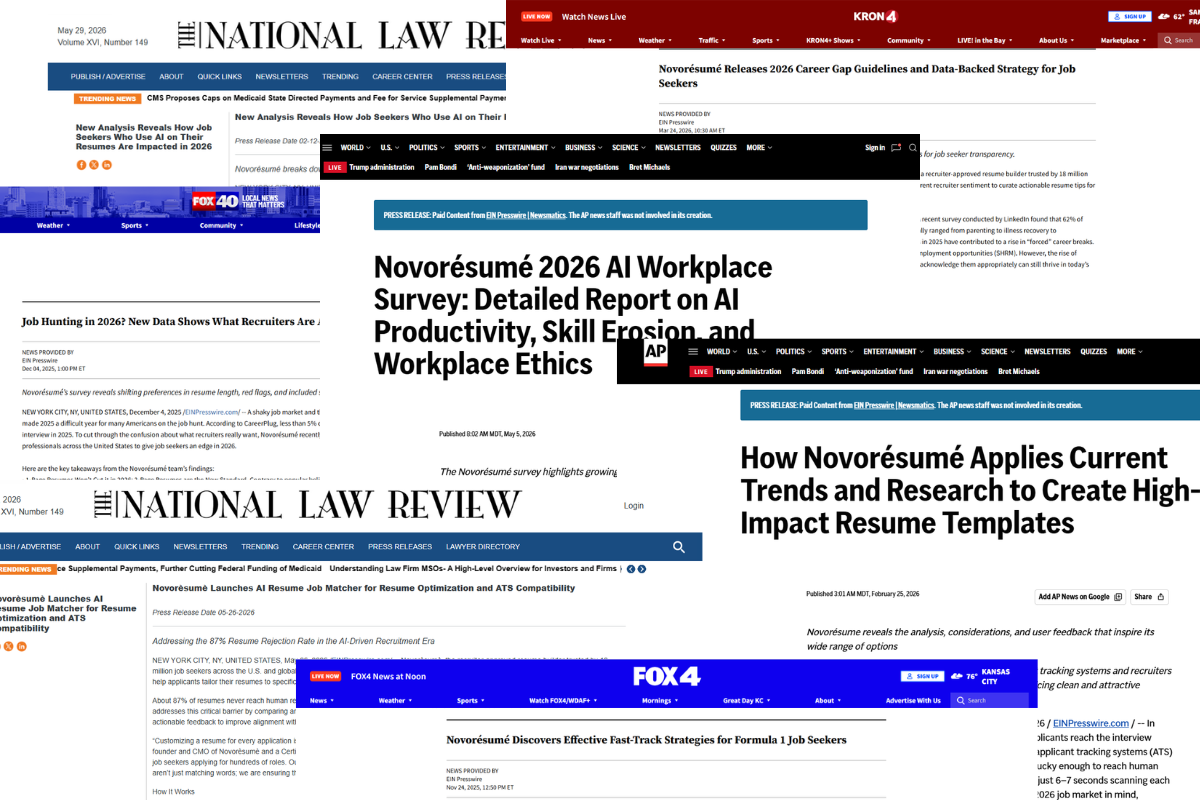
Beginning in November 2025, we committed to a rhythm: two press releases every month. This became the foundation of our AI visibility strategy.
Here’s how we structured it:
Release One was actively pitched to reporters and media outlets. It was traditional outreach, with journalists in mind. This maintained relationships and kept Novorésumé visible in conventional media. It was also optimized for GEO and distributed through EIN Presswire (a paid distribution service we use to get content syndicated across networks).
Release Two was GEO-optimized and distributed through EIN Presswire.
Two GEO-optimized press releases to feed LLMs with controlled content.
But here’s the secret sauce: The content didn’t stop there. The press releases often drew from Andrei’s blog and LinkedIn posts. Same information, different channels, repeated across multiple touchpoints. This multi-channel approach became the backbone of our digital PR strategy for the project.
The thinking was simple: if AI sees the same information show up in multiple places from credible sources, it starts to trust it and surface it when people ask questions. This is how you build a real AI visibility strategy—not through a single channel, but through coordinated, reinforced messaging.
The topics we chose were timely and specific. Each one was data-driven, useful, and designed to answer real questions people were actually asking.
By May, something shifted.
We had released a press release on how hiring difficulty varies by location in early May, and we started running searches to see how AI was surfacing the content. We tested different queries across ChatGPT, Gemini, and Claude to see what AI was actually surfacing and how it was prioritizing information. What we found was encouraging.
ChatGPT: When searching for information about difficult cities for job hunting in 2026, Novorésumé’s blog appeared as the top source, with the EIN Presswire press release ranking as the #2 source.
Gemini: Novorésumé’s blog appeared in the top four sources for a similar query. The EIN Presswire press release was the 5th source cited.
Claude: The National Law Review’s publication of the press release accounted for the first two sources, with Novorésumé’s blog listed as the 5th.
But here’s where things got really interesting: We started seeing genuine earned media pickups—the kind you can’t pay for, where journalists independently discovered our research and decided to use it.
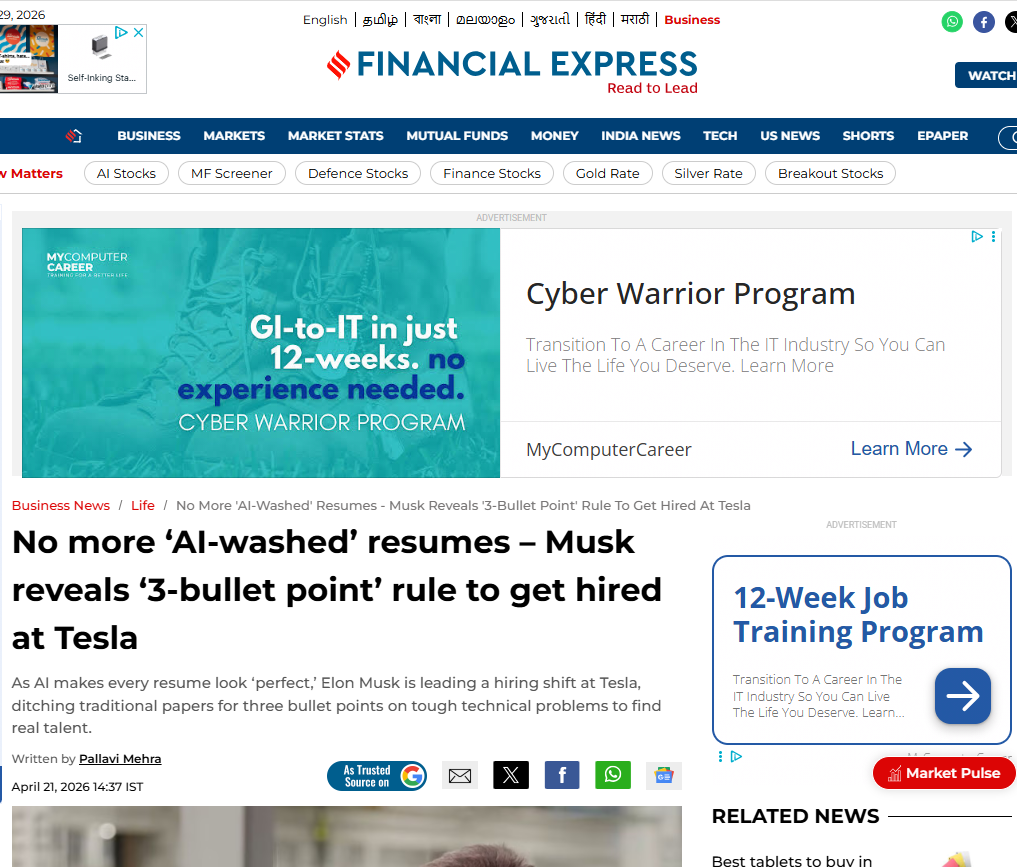
Financial Express published an article on April 21st that utilized data from our AI in the workplace survey. We’re uncertain whether she found the data through the press release or the blog article, but it was a significant mention from a high-authority publication.
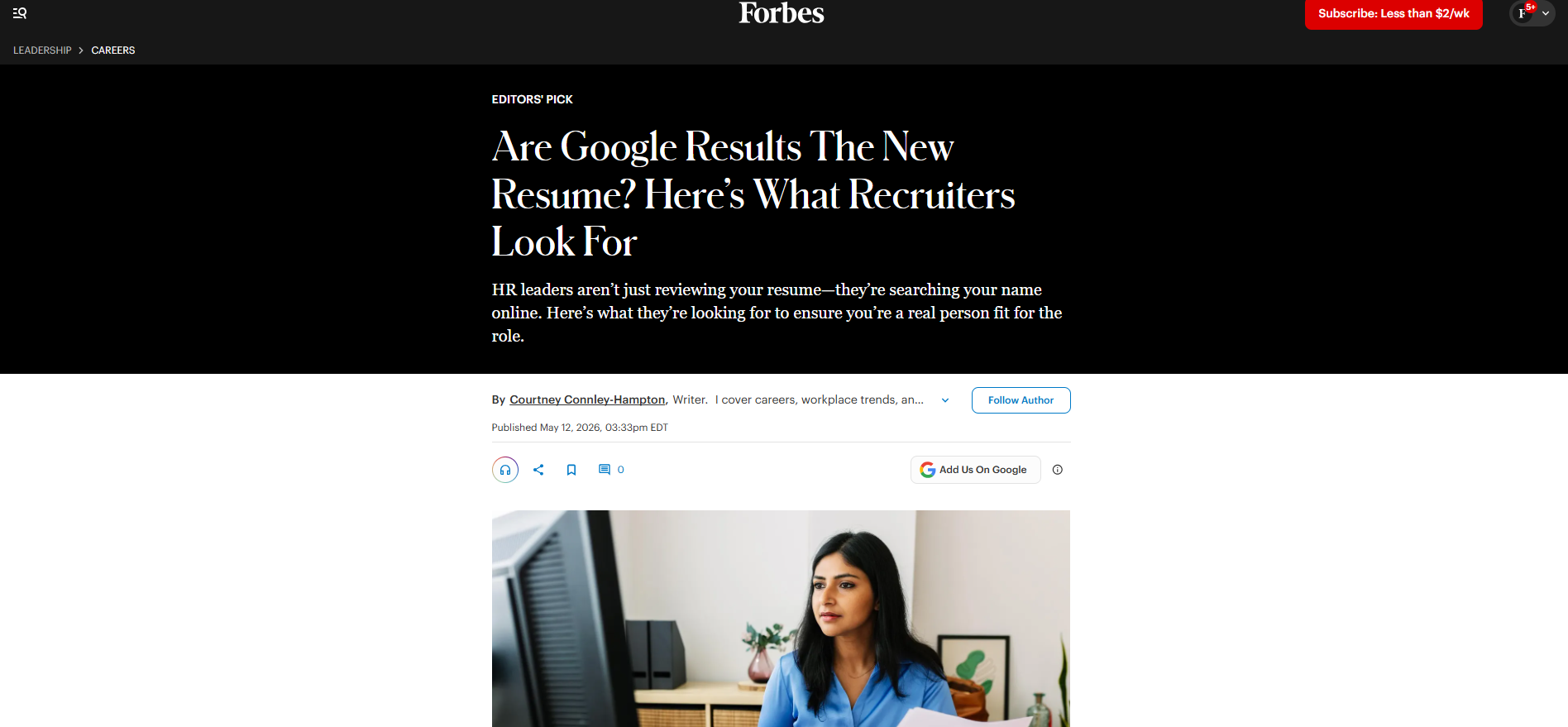
Forbes featured data from our January press release in an article published on May 12th. The article included a link to the press release as picked up by the Herald News, suggesting the reporter may have encountered it through their own research or media monitoring.
These earned media wins proved something important: our research was credible and useful enough that journalists were actively seeking it out and citing it in their coverage. That’s the validation you can’t manufacture.
Now, here’s the transparency piece: Both of our GEO-optimized releases were distributed through EIN Presswire, a paid service. We pay them to syndicate content across their network. That’s not organic earned media. It’s a tool in our toolkit, similar to paid distribution. But what we learned is that this tool, combined with our AI visibility strategy across multiple channels, actually works. The content got indexed. It got seen. And when paired with genuine earned media pickups and Andrei’s owned channels, it created a credible information ecosystem that both AI and journalists respect.
This project taught me something bigger than just “how to build an AI visibility strategy.” It taught me about the power of coordinated messaging across channels. When you have credible information and you distribute it thoughtfully through multiple authoritative sources—some owned, some earned, some paid—something clicks. Both AI and humans respect it more.
It also taught me the value of working with clients who are willing to experiment. Andrei could have demanded immediate results. Instead, he knew that understanding how AI search is changing PR meant being uncomfortable, iterating, and trusting the process even when we were learning on the fly.
We started this project knowing very little about GEO press releases. We’re still learning, but the results we’re seeing are evidence that the approach is working.
If you’re a business watching your visibility decline because of algorithm changes or AI shifts—whether you’re in financial services sharing research and insights, public health publishing important data, or any company with a compelling story to tell—don’t assume the old playbook will save you. The answer isn’t always to do PR better. Sometimes it’s to do PR differently—by understanding how AI search is changing PR and building a digital PR strategy that speaks to both humans and algorithms.
But here’s what we’re not abandoning: journalists and earned media are still essential. The Forbes and Financial Express pickups proved that reporters actively seek out quality research and information, regardless of industry. Our traditional media pitching didn’t stop just because we started thinking about AI. In fact, the best results came from doing both—building visibility for AI while maintaining relationships with journalists who value credible sources.
The future of visibility isn’t gatekept by journalists alone, and it’s not completely controlled by AI either. It’s a combination. The organizations winning right now? They’re the ones doing both. Building visibility for AI and maintaining relationships with journalists who actually care about good research. Whether they’re facing algorithm shifts, fighting bias in search results, or just trying to be found by the right audience—the organizations that figure out how to speak to both systems are the ones that succeed.
We’re still figuring this out, but the early evidence is encouraging. And honestly? That’s exactly the kind of challenge we want to be solving.

There’s a pattern I see with experiential brands that I want to talk about.
They’ve got a brand new seasonal experience and they freeze. Why? Because they don’t have photos yet. They hold back on pre-event marketing, delay media outreach, and quietly wait until they “have something to show.”
This is the exact moment where the best PR strategies for grand opening events get tossed aside because brands convince themselves they need to wait. If you’re holding back until the photographer delivers the gallery, you’ve already lost momentum.
We saw exactly how powerful taking up space early can be with two big event media relations services we ran: the Utah Tulip Festival and Tulip Valley Farms.
Down in southern Utah County, the family behind Glen Ray’s Corn Maze made a bold move and traded their fall pumpkins for spring petals. They introduced a brand new seasonal tulip field at Leland Legacy Farm, planted a quarter of a million tulips, and built a totally hands-on , u-pick field where guests could literally walk into the color.
The problem was we had ZERO photos of the fields in bloom, not a single one to work with.
So our strategy had to shift, and this is where experiential marketing and PR really earns its keep. Instead of leaning on past pictures to do the heavy lifting, we built something else: a clear, compelling picture of the experience in people’s minds. We didn’t focus on what it looked like; we focused on what it would feel like to be there.

Photo Credit: Last Chance Photography Venue: Utah Tulip Festival
We leaned hard into descriptive storytelling so people could imagine the moment, and we positioned the festival as a new spring ritual instead of just another event. We tapped into the curiosity of “something new is coming to Utah” and built early audience ownership for the people who wanted to be the first to discover it. As a result, Utah Tulip Festival pre-sold about $10k in tickets!
And the hype was wild. The festival was so successful that they made enough money to pay back their entire investment of 250,000 bulbs, and they even had funds left over for next year. That’s what the best PR strategies for grand opening events actually look like: real numbers, real outcomes.
Up in Washington, we partnered with Tulip Valley Farms, a family-owned farm run by Andrew Miller, a colorblind tulip farmer, and his wife Holly. They’re the only u-pick field featured in the famous Skagit Valley Tulip Festival, so we needed to differentiate them as the ultimate immersive experience. This is the heart of experiential marketing and PR. ou’re not just promoting an event. You’re selling a feeling people want to be part of.

Photo Credit: Last Chance Photography Venue: Utah Tulip Festival
But right at the start of their only revenue-generating month in 2025, the bottom started falling out of the broader industry. International tariffs hit, Canadian boycotts severely impacted local tourism, and neighboring farms saw revenue losses ranging from 20% all the way to 52%.
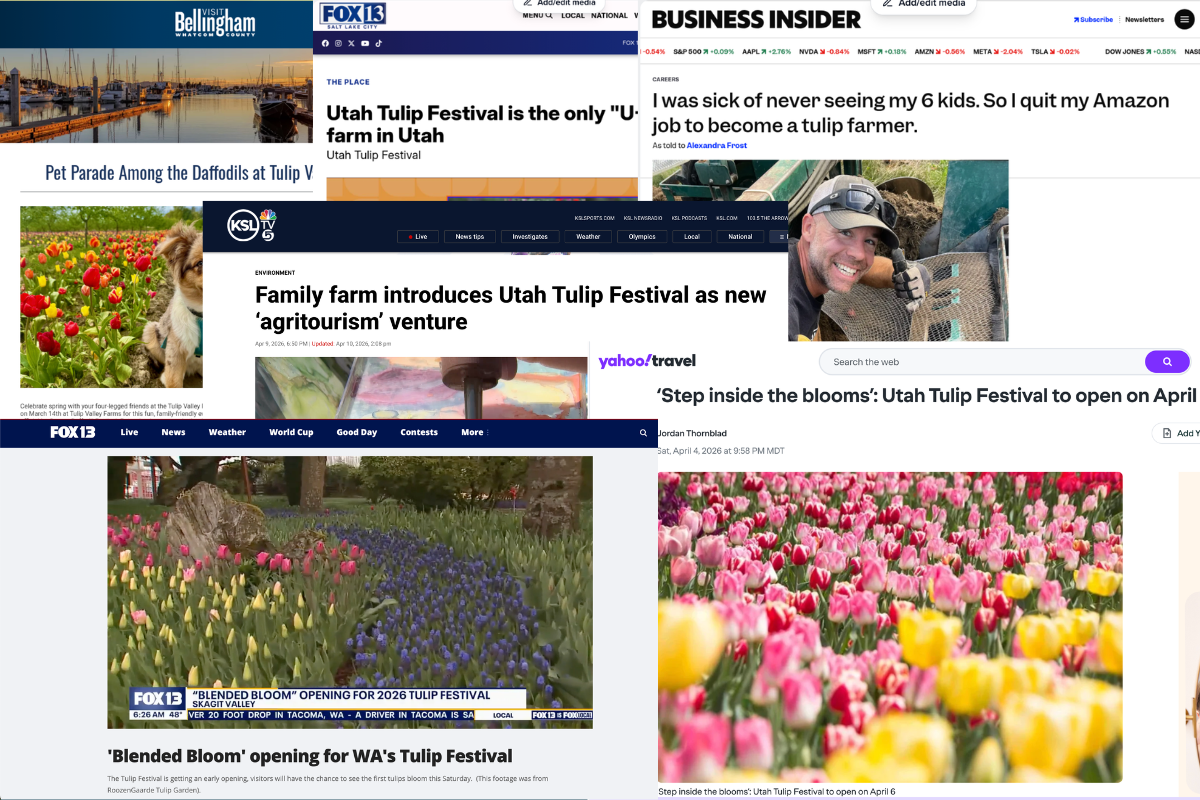
2026 Coverage

Photo Credit: Tulip Valley Farms
We weren’t about to wait around and see what would happen, so we got aggressive with our event media relations services and secured over 40 earned media placements in three months, including top-tier spots in Travel + Leisure and The New York Times before the festival even started. The tourism boards completely converted, which drove huge local word-of-mouth right when other farms were watching their numbers tank.
The 2025 results spoke for themselves. While competitors were bleeding revenue, Tulip Valley Farms hit a 35% increase in revenue and sold over 1,000 additional tickets compared to the previous year.
So in 2026, we doubled down. The tourism boards converted again, but this time we layered in influencers too. The top-tier press also fed directly into ChatGPT, which in turn helped drive ticket purchases for the farm and resulted in 81,000 website visits in a single month. Their total revenue was up 29% over 2025. Night Bloom tickets and revenue doubled, and overall, Tulip Valley Farms sold more of the higher-priced u-pick tickets. They also nearly broke even on the cost of paying the illustrator for their book, which was a huge win.
Storytelling is key. It’s the anticipation, the curiosity, the way you make people imagine themselves in the experience before it even exists. That’s what gets them to actually show up. Photos catch up eventually, but the story has to come first. That’s what good event media relations, along with experiential marketing and PR, really come down to.
So if you’ve been sitting on your hands waiting for everything to be perfectly polished before you start talking about it, please stop. Start now and build the hype before you have the proof. The best PR strategies for grand opening events don’t wait on the photographer, and neither should you.


